What We Offer
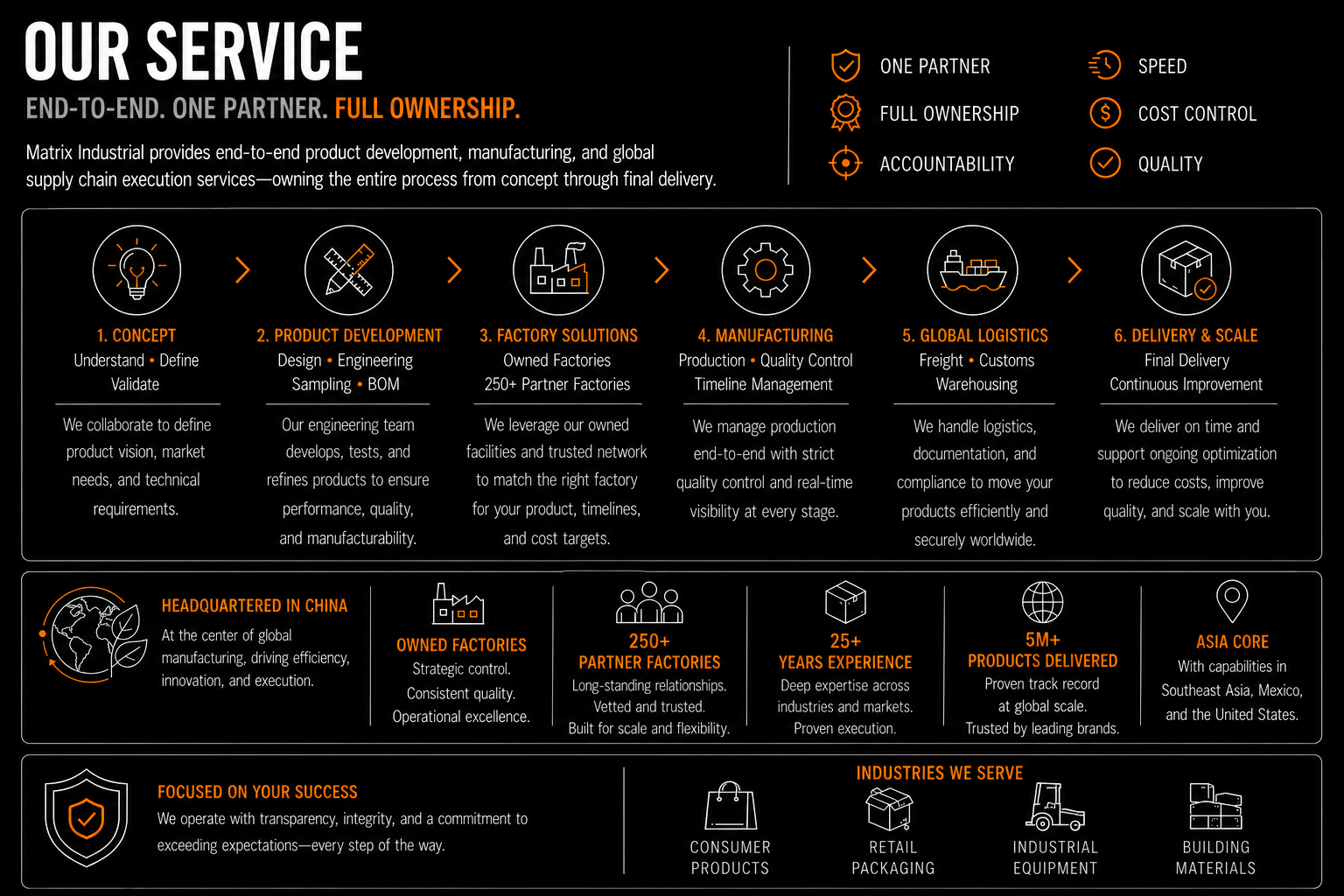
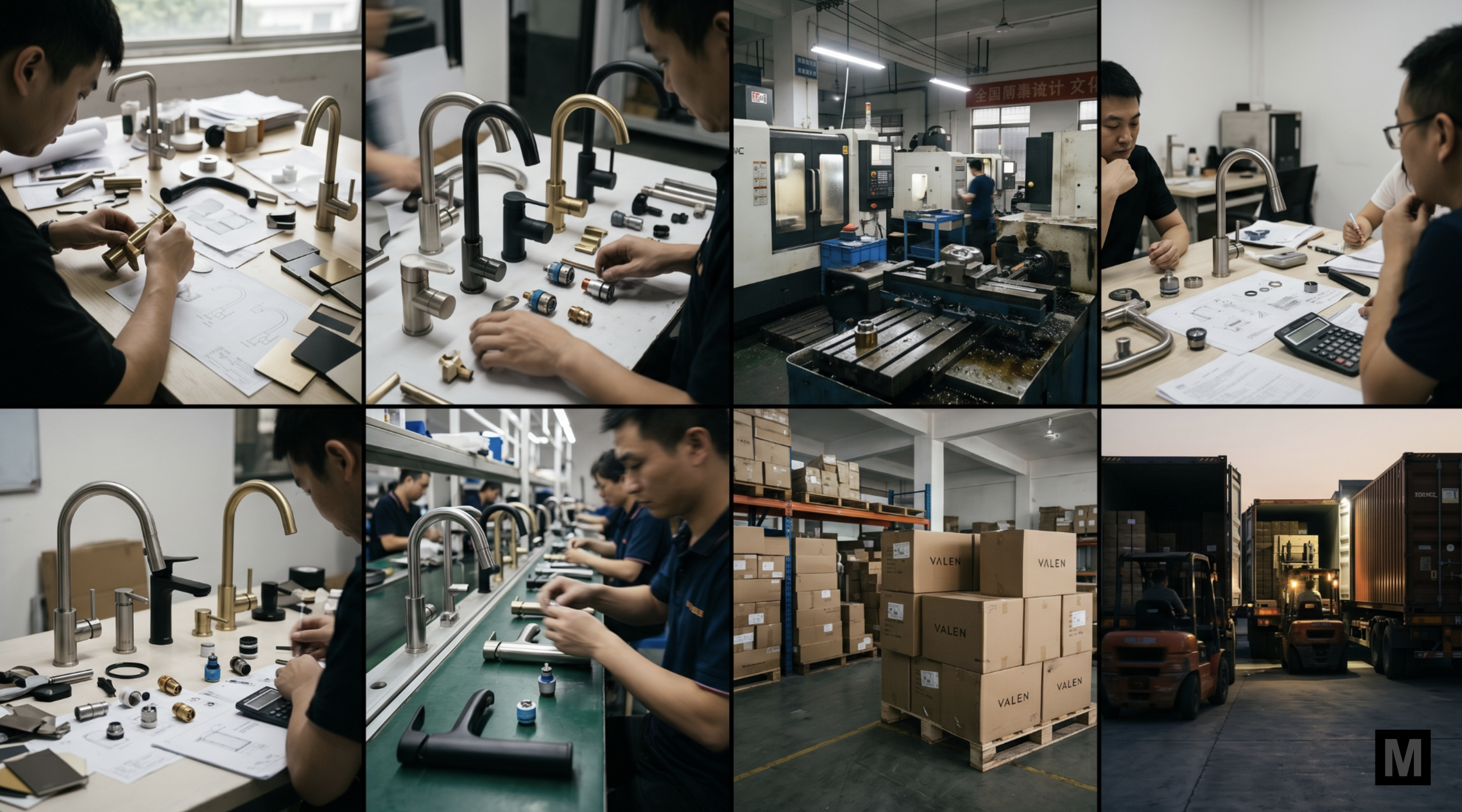
Matrix Industrial provides end-to-end product development, manufacturing, and global supply chain execution services—owning the entire process from concept through final delivery. We develop, engineer, manufacture, and deliver products at scale, giving you a single partner accountable for cost, quality, speed, and execution.
By combining engineering, direct factory access, and logistics into a unified operating model, we eliminate the fragmentation of traditional sourcing and bring full control to every stage of the product lifecycle.
Getting started is straightforward. We begin with a focused discovery session to align on your product, timelines, and objectives, then move quickly through development, sampling, and cost alignment before executing production and global logistics end-to-end—keeping timelines tight, costs controlled, and quality consistent at scale.

Our Step-by-Step Process
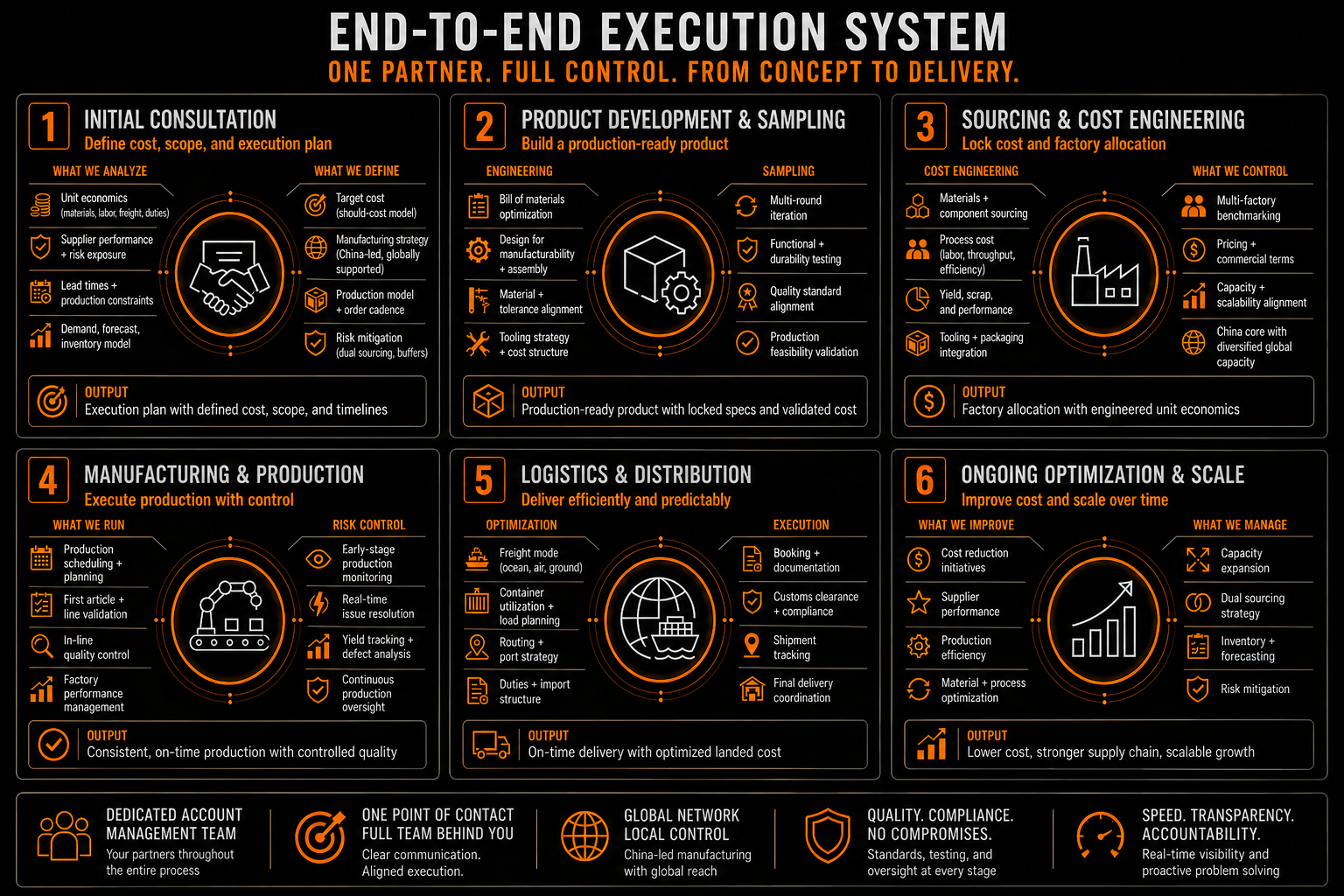
Our six-step process takes you from initial concept through production and final delivery with a clear structure at every stage. Product development, sourcing, production management, and logistics are each handled by dedicated teams, ensuring every decision is made with the right technical and operational expertise from the start.
You’ll work with a dedicated account management team that oversees your program and keeps everything moving. Behind the scenes, our teams coordinate across each phase—managing handoffs, timelines, and priorities—so the entire process runs as one system. The result is a streamlined path from idea to delivered product, with alignment across cost, quality, and timing throughout.
Step 1: Initial Consultation (Free)
Goal: Align on your product, business model, and supply chain strategy
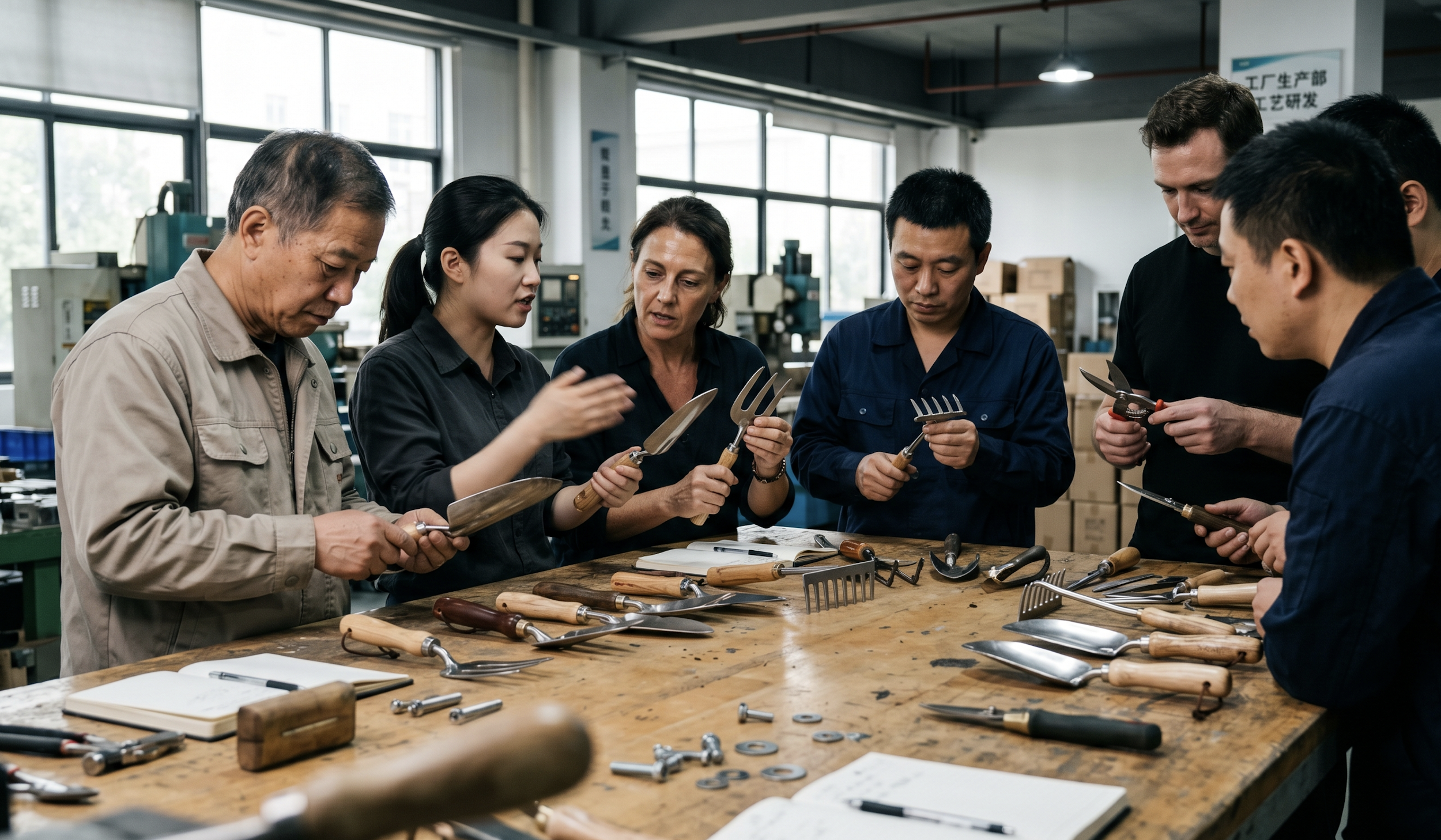
We run a working session that goes beyond product review. We break down your current supply chain, cost structure, and sourcing strategy to understand where margin is being gained or lost—and where risk exists.
We assess how your product should be built, where it should be built, and what it needs to cost to support your business objectives.
What we analyze:
Full unit economics: raw materials, conversion cost, labor, overhead, packaging, freight, and duties
Supplier concentration risk and geographic exposure
Lead time structure across tooling, production, transit, and inventory cycles
Demand profile, order cadence, and safety stock strategy
Margin targets versus current landed cost
What we define:
Target cost structure (should-cost versus current cost)
Manufacturing strategy (China-led with regional diversification where needed)
Production model (batch size, minimum order quantities, reorder cadence)
Risk mitigation strategy (dual sourcing, buffer capacity, material strategy)
Output:
A fully defined execution plan grounded in real cost, capacity, and timeline constraints.

Step 2: Product Development & Sampling
Goal: Engineer the product for scalable, cost-efficient production
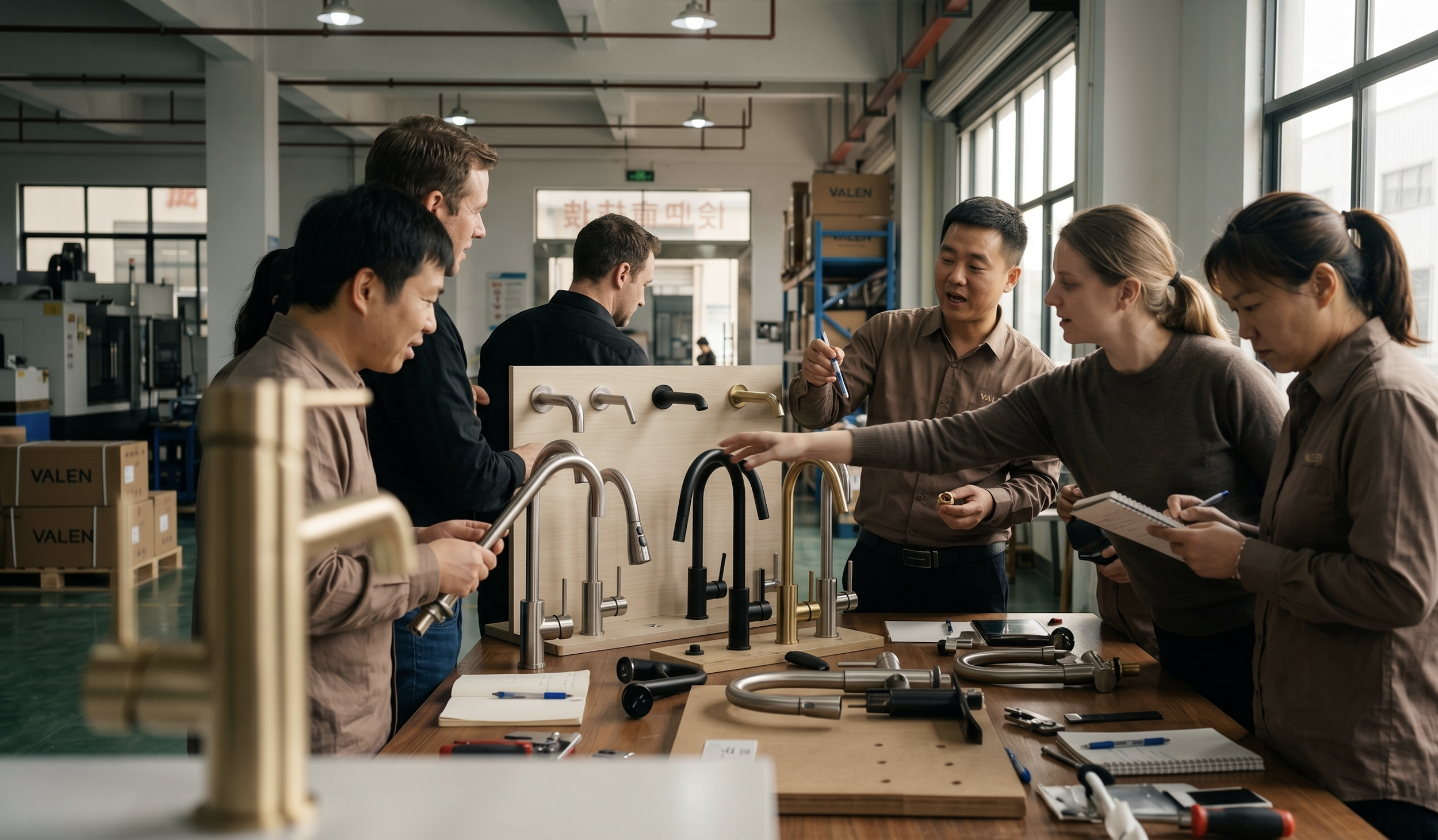
We take ownership of product development at the engineering and manufacturing level, ensuring the product can be produced consistently, at cost, and at scale.
We refine the product to eliminate unnecessary complexity, reduce cost drivers, and align with the most efficient production methods.
What we engineer:
Bill of materials optimization (material selection, substitutions, consolidation)
Design for manufacturability and design for assembly
Tolerance alignment based on production method and factory capability
Tooling strategy (molds, dies, fixtures, and cost amortization)
Packaging integration into the production process
Sampling process:
Multi-round sampling with structured iteration
Functional testing, durability validation, and quality benchmarks
Alignment between sample quality and mass production capability
Output:
Production-ready product with locked specifications, validated cost, and no surprises at scale.
Step 3: Sourcing & Quoting
Goal: Engineer cost and allocate production to the right factory
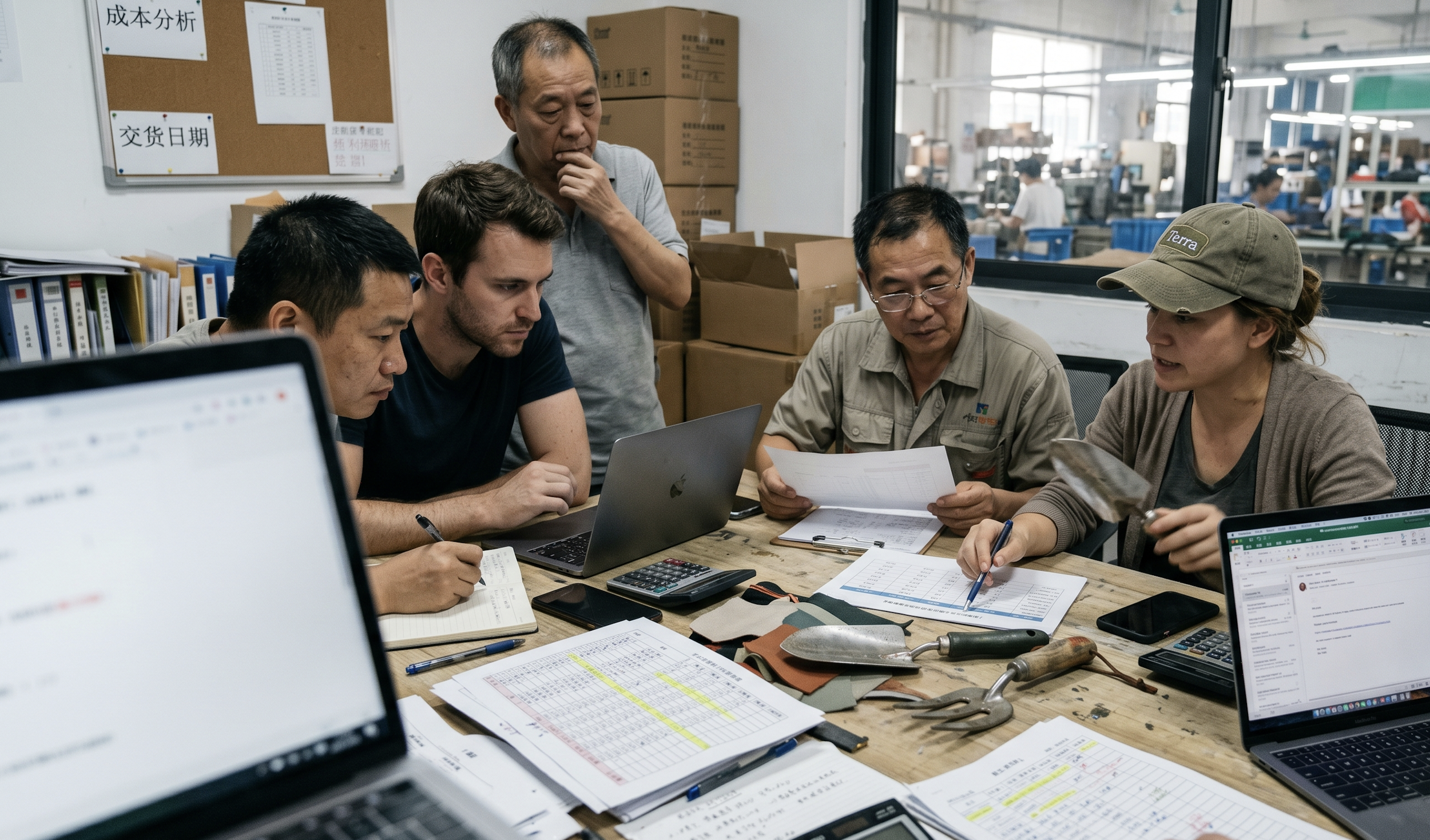
We allocate production to the right manufacturing partner based on capability, cost structure, and scalability—not just price.
Every quote is broken down to understand true cost drivers and identify opportunities for savings.
What we break down:
Raw material sourcing and cost exposure
Production process cost (labor, automation, throughput)
Yield assumptions and scrap rates
Tooling amortization across volume scenarios
Packaging and assembly integration
Freight assumptions and landed cost modeling
What we control:
Multi-factory benchmarking to create pricing leverage
Negotiation of pricing, minimum order quantities, and payment terms
Lead time alignment and production scheduling
Capacity planning to support future growth
Regional diversification when required, anchored in China with additional capacity across Southeast Asia and Mexico
Output:
Final factory allocation, fully engineered cost structure, negotiated terms, and a scalable production plan.
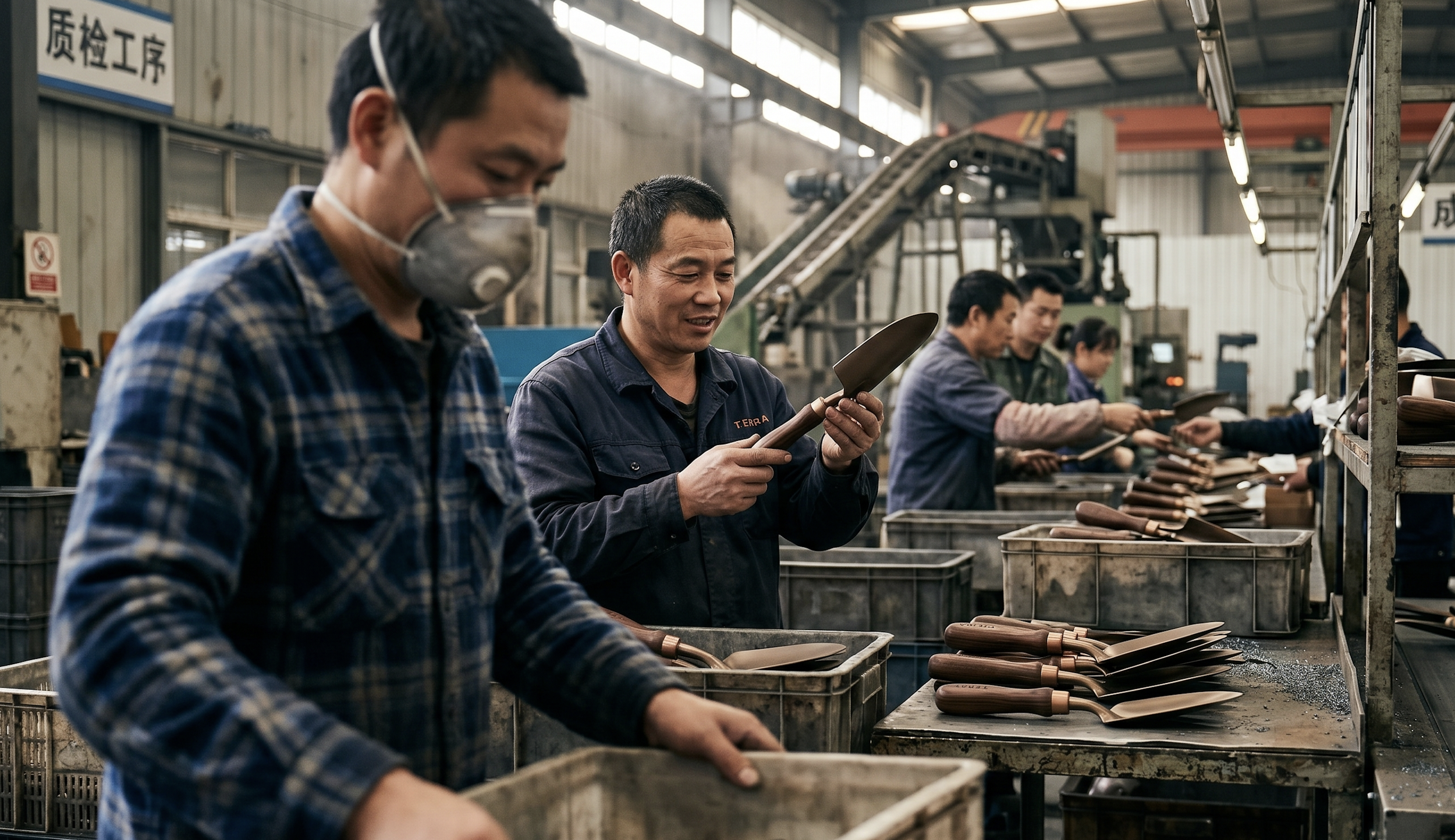
Step 4: Manufacturing & Production Management
Goal: Execute production with precision, visibility, and control
We actively manage production with direct oversight inside the factory, ensuring alignment on quality, timelines, and output.
What we run:
Production scheduling aligned with shipment and inventory targets
Line setup validation and first article approval
In-line quality control throughout production
Yield tracking and defect root cause analysis
Factory performance management (output, efficiency, adherence to plan)
How we prevent issues:
Early-stage production monitoring to catch problems before scale
Ongoing tracking against production milestones
Direct issue resolution within the factory environment
Optional:
Third-party inspections
Compliance and regulatory testing
Certification management
Output:
Consistent, repeatable production delivered to specification, on time, with minimized variability.
Step 5: Logistics & Distribution
Goal: Optimize total landed cost and delivery reliability
We treat logistics as an integrated part of the cost structure, optimizing for both efficiency and reliability.
What we optimize:
Freight mode selection based on cost and urgency
Container utilization and load planning
Routing strategy and port selection
Duties and import classification
Warehouse and distribution alignment
What we manage:
Freight booking and documentation
Customs clearance and compliance
Shipment tracking and exception management
Coordination with warehouses, distribution centers, and third-party logistics providers
Output:
Predictable, cost-efficient delivery with full visibility from factory to final destination.
Step 6: Ongoing Optimization & Support
Goal: Continuously improve margin, resilience, and scalability
We actively manage and improve your supply chain over time, ensuring it becomes more efficient and resilient as your business grows.
What we drive:
Continuous cost reduction initiatives across materials and processes
Supplier performance monitoring and improvement
Capacity expansion planning
Regional diversification and risk mitigation
Inventory and forecasting alignment
What we monitor:
Cost drift and margin pressure
Supplier dependency and risk exposure
Production bottlenecks and scaling constraints
Output:
A supply chain that improves over time—lower cost, stronger performance, and scalable for growth.